
When God’s presence unsettles us…
The power and influence of the world around us is undeniable. We like to think that we can do something about it, but our power is limited to make any real change. Time marches on, and we can’t ever be certain about what tomorrow holds. Storms rage around us. Normal never seems to last. Peace is hard to find.
We open our mouths and make a mess of everything because we can’t even control our own tongue. We’ve lots of regrets and if we’re man enough or woman enough to own them, good for us, but pride is usually our worst enemy, and this only concerns our own existence, it doesn’t include all the other things that we can’t control around us, like the weather.
But one night, long ago, all of this changed—even the weather. A man was standing in a boat in the middle of a storm, and He did what no man can do. He told the weather—a storm—to calm down, and it did! (Matthew 8:23-27)
“What sort of man is this?” The disciples cried out. They wondered, “If even the wind and waves obey Him, what else does He have authority over?” That night, out there on the boat in the middle of the sea, the disciples had a hard time wrapping their minds around Jesus Christ. And we can’t blame them for that. After all, it’s natural and normal enough for people to think of God as the One who has power to control and change things like the weather, but people normally think of “God” as something or some being far, far away, somewhere beyond the cosmos, far removed from our everyday experience. However, what do you do when God is standing there with you in the boat? Just let that sink in for a minute… it’s unsettling, to say the least.
Is Christmas any less unsettling?
Christmas—just a few days away—confronts us with a similar strange and confounding thought: What do we do with the reality of God becoming a flesh and blood baby? LIke the disciples on the boat, wondering what sort of man Jesus was, I wonder if the Virgin Mary might have asked something similar when she beheld the sight of her newborn wrapped in swaddling clothes and manger straw: “What sort of baby is this?” Or what did the shepherds think as they came cautiously to the stable, with visions of angels still burned in their eyes, and that angelic announcement still echoing in their ears: “For unto you is born this day, in the city of David, a Savior, who is Christ the Lord. And this will be a sign for you: you will find a baby wrapped in swaddling clothes and lying in a manger” (Luke 2:11-12). Then said the shephers: “What sort of child is this?”
Such questions address the sheer wonder of the incarnation of our Lord. The strange truth that God would become so close to us, so available; it is the true wonder of Christmas. It is the joy of Immanuel—the unlikely, seemingly impossible truth that God is with us.
In the Old Testament, they didn’t have God in the flesh. O sure, you read between the lines and the prophets are filled with hope that God was and would be an immanuel sort of God (immanuel means “God with us”). That idea wasn’t alien to ancient Israel. I think they alwasy assumed God would be involved in their lives. For them God parted the Red Sea. For them fell manna from heaven for 40 years. They were led by pillar of fire and cloud. God made Himself abundantly available. This provison and presences was consistently the very thing that set God apart from any other so-called god. But how could they have ever dreamed that He would do and be everything He actually turned out to be in Christ? Would they have ever believed something as strange as God in a manger?
How does all this apply to Psalm 86?
Today we reflect on Psalm 86. It’s a psalm asking the Lord to be with you in full knowledge that He is the one who really is Immanuel and really can calm real storms–not just in the astmosphere, but King David trusts that God has a plan to calm the storms life, too. Consider the following phrases:
“Incline your ear, O LORD, and answer me… (vs.1)
“For You are good and abounding in steadfast love… (vs.5)
“There is none like You… nor are there any works like Yours. (vs.8)
“You are great and do wonderous things…” (vs.10)
“Great is Your khesed love toward me…” (vs.13)
“You, O LORD, are a God merciful and gracious, slow to anger
and abounding in khesed and faithfulness. (vs.15).
After reading these phrases, we could ask along with the disciples and Mary and the shepherds, “What sort of God is this?”
According to the psalm, He is worthy of us placing our hearts and our lives and our worries and our fears and our failures and our very worst into His hands. When the bottom falls out He’s worthy of our prayers. When answers are needed, He’s worthy of our petitions. When darkness clouds our vision, He’s worthy of every ounce of faith we can muster. He is steadfast and faithful, even when we feel faithless and worn out. — All this sounds too good to be true. But it is! Indeed, what sort of God is this?
None of this is to say that every single problem or everything we need changed is going to get fixed immediately, or at all. But it does mean that the chaos of the present age in the end is not going to drown you. You’re drowned already in the waters of your baptism, which simply means that you’ve been linked by God’s Word to Jesus Christ, Himself, who is the Word made flesh, and who has gone through the worst of storms, through the eye of death, and walked out the other side. And if you’re linked to Jesus like this, then it means that even in the face of the worst, even when you die, yet you shall live.
This is powerful stuff.
What sort of Man is this?
Have you ever thought this way about of Baptism? It is quite literally a linking by Word—God’s unchangeable, all-powerful Word—to the Word Himself. You are connected to Jesus. And this then prompts another very important question: What sort of man, what sort of woman are you?
The answer: You are child of God. You are in Christ. You belong to Him. This is the very central truth that that makes Psalm 86 such a beautiful prayer for us as much as it was David’s prayer, long ago. Only those who are children of God can rightly pray this prayer.
Something else to consider…
Consider the very important imperatives in this psalm. The Psalmist cry’s out three times:
“Incline Your ear, O Lord…
Give ear, O Lord, to my prayer;
Listen to my plea for grace” (vs. 1&6).
We could rightly wonder what gave David the presumption to talk to God this way? David dares to tell God to “listen.” Who dares tells God to listen? That’d be like students in a Sunday school class telling the teacher to sit down and listen. Listening is the students job, not the teacher’s. Listening is our job, not God’s. But what if in the middle of a lesson, a student suddenly shouted out to her Sunday school teacher, “You listen to me!” Wouldn’t such rude behavior turn heads and cause gasps? It’s so disrespectful.
But see… this is precisely what makes Psalm 86 shocking, too. David says, “Listen to me, O Lord, and answer me…” This is especially shocking considering that David, himself, wasn’t always such a great listener to God’s word. Remember David’s roof-top incident with Bathsheba? What gave an adulterous, murderous sinner like David the right to demand of God, “Listen to me”?
The hope of “immanuel” makes us bold before God.
Where did David’s boldness come from? I guess it was all the ways that God had always assured David of His presence. The hope of immanuel is powerfult, that way. Like a little boy feels confident to be direct with his parents because he knows mom or dad will always be there and never NOT love him, in the same way, we can rejoice that that God would inspire David to write this prayer! God’s khesed, steadfast love did this! His faithfulness put this prayer on David’s lips. The hope of immanuel gave David the courage to be so direct with God.
This psalm, and others like it, exists so that we might know just exactly how much God wants to give us His attention. He wants us to demand it. He wants us to know that like verse 15 says: He is “compassionate and gracious, slow to anger and abounding in steadfast love and faithfulness.” He’s the God in the manger. The God in the boat. The Good Shepherd who leads us through green pastures and dark valleys. Our Savior and our Proof through all time and eternity, that God is for us. That’s why prayers like this are recorded for us to read and copy, again and again.
You see, it’s okay for believers to claim a slot in God’s busy schedule. And why? Because of everything God has done for us in Jesus Christ. God wants us to have, like the old hymn says, “Blessed Assurance.” Assurance enough that we might boldly bring all our concerns and fears and even our sin—especially our sin—into His presence. It is for this reason that we conclude all our prayers by saying, “for Jesus’ sake. Amen.”
So go ahead and boldly entreat God’s holy attention. He loves you. He loves you for Jesus’ sake. He loves you especially when you are “poor and needy” and when you “cry for mercy” as the psalm says.
A final thought…
That night on the boat, out on the sea in the darkness, the disciples’ question–“What sort of man is this?”– powerfully foreshadows the overarching purpose of why we celebrate Christmas. This is the One who is IMMANUEL!
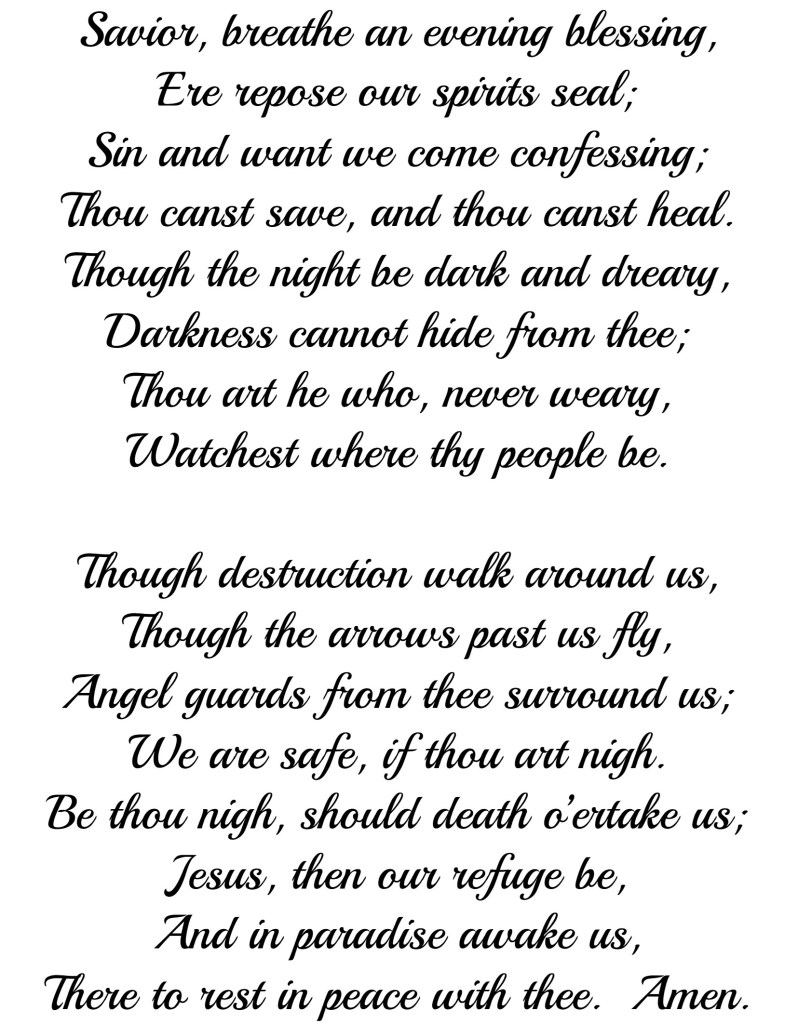
It’s why I love the hymn we’ve sung together at the beginning of each Advent service: “Savior, Breathe an Evening Blessing.” It comes from the old 1940’s Lutheran Hymnal, and even though the words are a bit antiquated, how beautifully it expresses the certainty and blessing we can have knowing that Jesus is our God in the boat with us.
In Jesus’ name. Amen.
 O Lord, open my lips...