What’s the Big Deal about Christ’s Ascension?
By Pastor Aaron Kalbas
So what’s the big deal about Christ’s Ascension?
It’s not something the world celebrates like Christmas or Easter. Even in the Church, Pentecost often gets more attention. And yet the Ascension stands right there in the Creed, alongside every other saving work of Christ: conceived, born, suffered, crucified, died, buried, risen—and ascended into heaven. We confess the Ascension of our Lord as part of the saving work of Jesus. But do we always treat it that way?
Years ago, most Lutheran congregations did, in fact, celebrate the Ascension of our Lord on the day itself—which was this past Thursday, 40 days after Easter and 10 days before Pentecost. But that practice has largely faded. Now, when it is observed at all, the Ascension of our Lord is often moved to the following Sunday, as we have done today. And even then, sometimes it is treated more as a minor footnote in salvation history.
So again: what is the big deal about Christ’s Ascension?
Well, first, let’s clear up some confusion about the Ascension. At lot of times, our confusion is this: Jesus went back to where we assume He belongs. He’s true God, right? And if He is true God, then, of course, heaven seems like the proper place for Him. So maybe the Ascension does not strike us as all that astonishing. God being born in the flesh at Christmas—that is astonishing. God dying on a cross on Good Friday—that is astonishing. God rising from the dead at Easter—that is astonishing. But God going to heaven? That can start to feel almost expected, almost ordinary.
And that is where we can go wrong in our thinking about Christ.
Because we tend to think that since Jesus ascended into heaven (went back home), then Jesus must be gone—out of sight, out of reach. And maybe that says something about what we think about God in general: that He is distant and removed from our lives. Sure, He left us the Bible. We can learn about Him and hear His promises. We can pray to Him, and the Holy Spirit is here with us—but Jesus Himself has left the building.
But that is not what the Bible says. Jesus does not say, “I’m leaving you now. Good luck.” He says, just before His Ascension, in Matthew 28:20, “Behold, I am with you always, even to the end of the age.” And St. Paul says in our Epistle reading today from Ephesians 1 that the ascended Christ now “fills all” things.
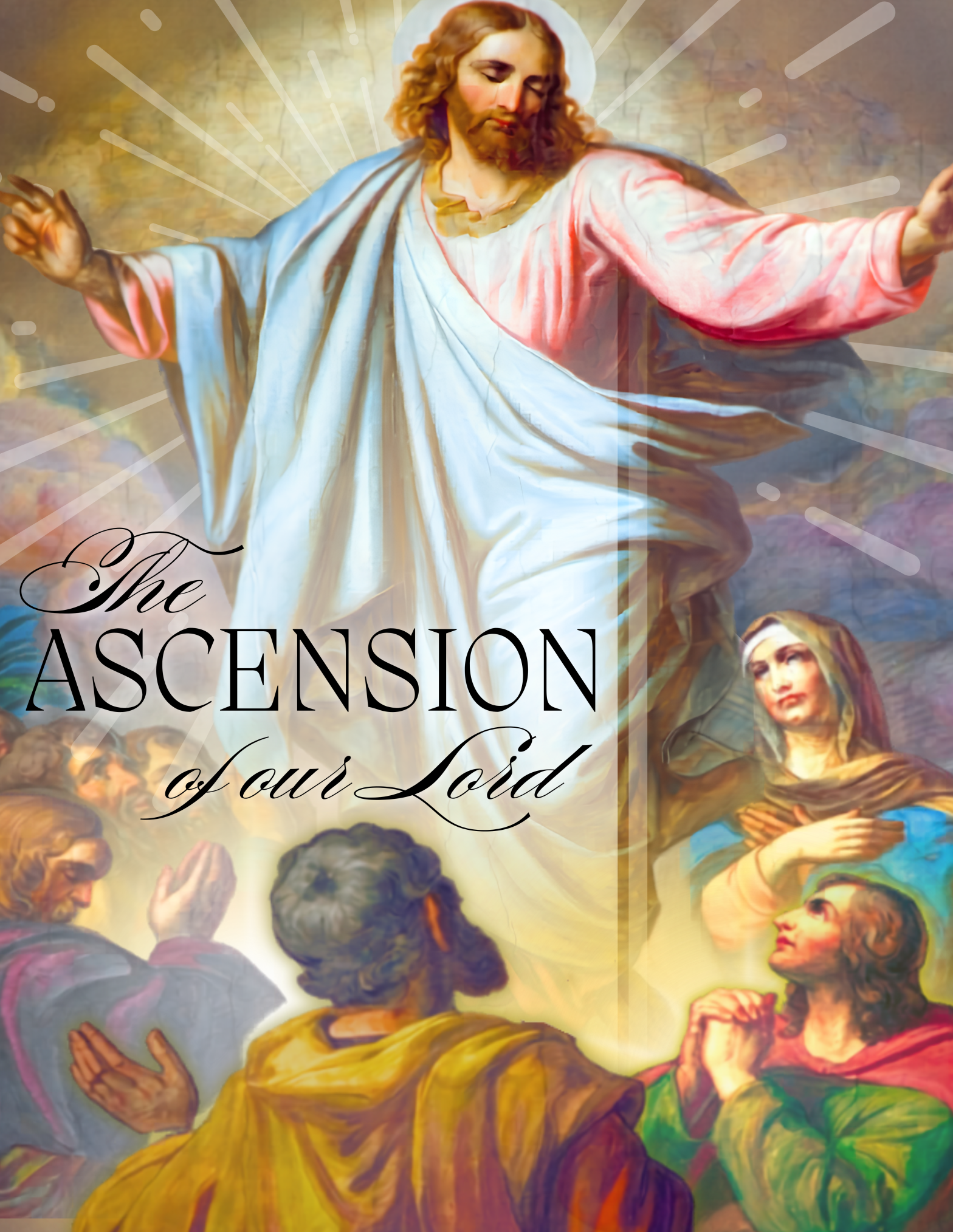
So the Ascension is not about Jesus becoming less present. It is about Jesus making His presence known in a greater way. He did not ascend to remove Himself from His Church. He ascended to fill all things—to be a part of every work of the Church—to be present for His people always and everywhere. Thus, the Ascension then is not Christ’s absence. It is the enthronement of His presence over all creation.
When we confess the Creed today—the Nicene Creed—we are confessing the great works of Jesus. And if you listen closely, you can hear that they fall into three time frames: past, future, and present.
Most of them are past. He was incarnate by the Holy Spirit of the Virgin Mary and was made man. He was crucified for us under Pontius Pilate. He suffered. He was buried. On the third day He rose again. Those are mighty, saving works of Christ, but they are past events. We do not live inside those moments. We receive their benefits, yes, but those events themselves are not happening now. We hear them proclaimed. We believe them. We live from them.
Then one article points us forward: He will come again with glory to judge both the living and the dead. That is still ahead of us. That is our certain future.
But there is one article of the Creed that tells you what is true of Jesus right now, at this very moment, right now, and that is: He ascended into heaven and sits at the right hand of the Father.
That is the present-tense reality of the Christian life. That is where Jesus is now. That is what He is doing now. And this changes everything.
It means your Lord Jesus Christ is not stuck in the past, as if He only matters in memory. And He is not only waiting for the last day, as if His real work is still on hold. No—right now He reigns. Right now He intercedes. Right now He rules all things for the sake of His Church.
This is the reality that governs our lives now. This is what shapes our prayers, our confidence, our courage, and our hope. We live in a fallen world, yes—but we do not live in a world out of control. Jesus has ascended into heaven and sits at the right hand of the Father. And that means the crucified and risen Lord is reigning for you, even now. This is the first and most significant aspect of the importance of the Ascension of our Lord.
_________
The second most important aspect is that the Ascension, which was the last act of our Lord’s earthly ministry, helps put into perspective the very first act of our Lord’s earthly ministry—His incarnation.
And here is one way to picture it.
Imagine two columns on a page. On one side are the things that belong to God: eternal, without beginning or end, almighty, holy, glorious, ruler of all. On the other side are the things that belong to man: born, hungry, tired, suffering, bleeding, dying, buried.
Those two lists do not belong together. They are as opposite as can be. But in Jesus, they come together.
That is the shock of the Incarnation. God steps into our side of the page. In Jesus, God is born. God gets hungry. God grows tired. God suffers. God bleeds. God dies. That is the humiliation of Christ. That’s the mystery of the Incarnation.
But the Ascension means that is not the end of the story—that God didn’t just do this as a temporary thing. No! In the Ascension, Jesus does not drop His humanity and float back to heaven as if being human were just a short-term gig. No—He takes our humanity with Him into glory. You see, where the Incarnation brings God over to man’s side of the page, the Ascension does the opposite. It brings man over to God’s side of the page. For in Christ, now a man sits on the throne of God (how astonishing is that!). In Christ, now a man reigns over all things. Jesus, one of us, lives forever in glory—and in Christ, so will we. Because in Christ, man now belongs in heaven just as God does. Not just because Jesus was God and man. Rather, because Jesus IS both God and man by virtue of His ascension.
This means who you and I are is not discarded; because we are a part of Christ’s body, our humanity is carried into heaven in Christ. What is deepest and most true and unique about you is not erased. Your identity is not lost. As Paul says in Ephesians 2, we are seated with Christ even now—in heaven—because we belong to Him.
So when you wonder what God thinks of you because of your sinful flesh and frail humanity, look to the Ascension. It’s sort of the cherry on top of a wonderful ice-cream sundae of salvation. He loved you and me enough not only to enter our misery, but to raise up who we are into His glory. That is the heart of John 3:16: God gave His Son so that you would not perish, but have eternal life. Jesus took what was yours—suffering, death, and shame—and gives you what is His—life, joy, holiness, and peace.
______
This makes the Ascension a thing of great mystery on par with the Incarnation. Like a husband and wife, what belongs to the one belongs to the other. They share the same name, the same life, the same hope, the same future, the same family. So also, you are wedded to Christ, and you share the same life and joy and peace because He was born in the flesh, is risen from the dead and ascended into heaven.
And you know, when we forget about the Ascension, that’s when so many errors can enter into the Church: when we forget the Ascension, we forget that Jesus Christ is not merely risen, but reigning. We forget that He is seated on the throne, above every power, dominion, and authority. We begin to think that Jesus is struggling to manage the crazy world we live in, wringing His hands over history, distant and removed from His Church.
Indeed, when we forget what the Ascension means, we start to live like unbelievers. We worry. We fret. We grasp. We hoard. We panic. We doubt His care, question His rule, and act as though everything depends on us. And so our anxiety then reveals not the size of our troubles, but the smallness of our faith in Christ.
We say Jesus is Lord, but live as though the throne were empty. We live as though heaven has no King. Why? Because in those moments, we are functionally denying the Ascension. We live as though Jesus has stepped away, as though He has gone silent, as though He has left His people to fend for themselves.
Sometimes suffering makes that lie feel plausible. Suffering can make it seem as though Christ has taken a break, as though He has forgotten you. But He has not. He reigns for anxious Christians like you and me. He is not ashamed of fearful disciples. He rules even when we are weak or we fail or are unfaithful. The Ascension means that the crucified and risen Christ now rules all things for the good of His Church—and the good news is, that includes you!
In Jesus’ name. Amen.

