1 Samuel 7:7–14 | By Pastor Aaron Kalbas
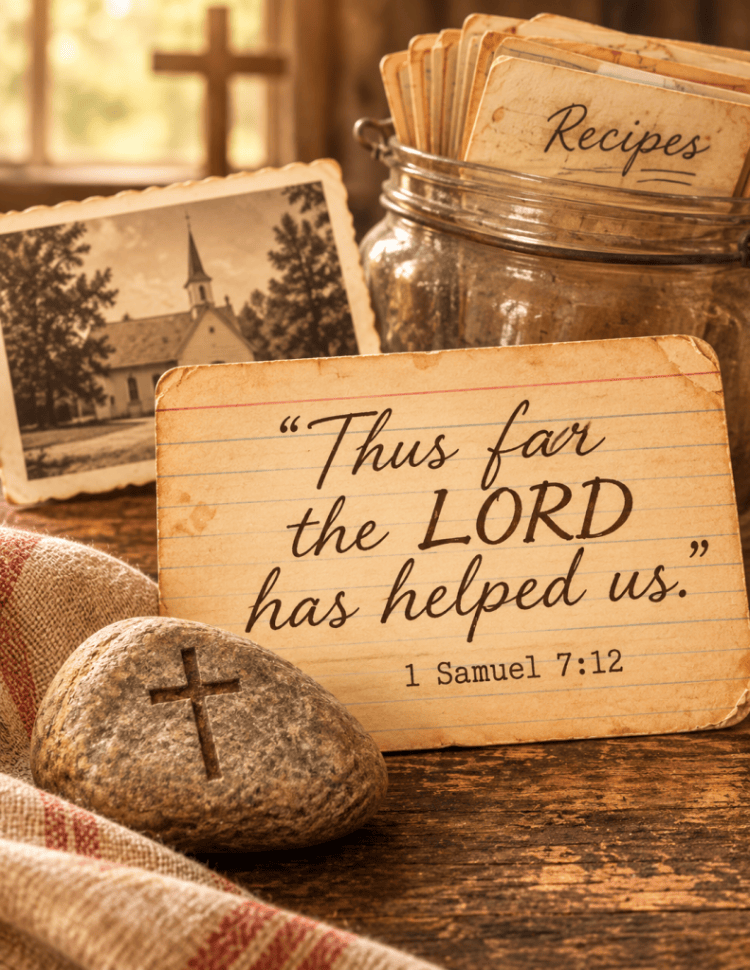
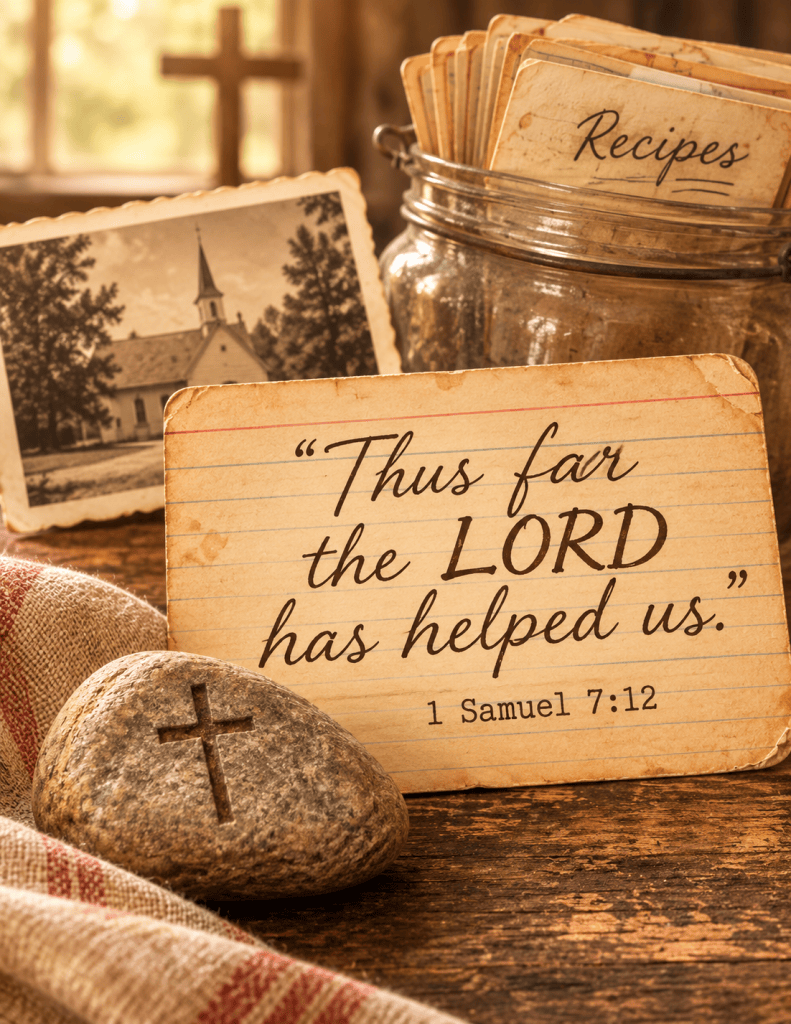
I want you to think for a moment about the last time you opened an old box or trunk from the attic. Maybe it held old family photos, the edges curled and the colors faded, but the memories still seemed fresh in your mind. Maybe it was the recipe box you opened this week getting ready for Thanksgiving. All those recipe cards in your grandmother’s handwriting, with a grease stain in the corner that you would never want to wash away—you’ve read them a hundred times. Or maybe it’s an old family Bible with names written inside the cover.
And how do all these stained, yellowed, and aged mementos make you feel? They probably bring a smile to your lips or maybe a tear or two to your eyes.
This feeling has a name: nostalgia. It is a longing for something that is gone. And, of course, this time of year, it’s everywhere. We are drawn to the old photos, the old recipes, the old stories shared around the table.
Now, obviously this kind of longing and remembering isn’t sinful. God made us to remember. But tonight, I want to ask a question: What do we do with these feelings? Do we just ache for the “good old days,” or can that ache become something that actually strengthens our faith?
Earlier, we read 1 Samuel 7:7–14. It teaches us something of the difference between nostalgia and biblical remembrance. While nostalgia looks back with longing, biblical remembrance looks back with faith. And like my sermon from this past Sunday, our text today also teaches us that remembering God’s past faithfulness fuels our present gratitude and our future trust.
In our text, Samuel sets up a “remembrance stone.” But before we get to the stone, we have to understand where Israel was standing when it was set up. They weren’t gathered around a cozy dinner table. This was a battlefield. And there they were ready for a fight, and the banners were flapping in the wind. They looked very much the part—God’s people Israel—but the problem was that for twenty years, Israel had drifted spiritually. They had chased idols, and they had suffered defeat. They called themselves God’s people, but they hadn’t actually lived like it. And now the Philistines have assembled and were ready to attack.
Verse 7 says that Israel was afraid. They were trembling. But this fear causes them to return to the Lord. They confess to Samuel, “We have sinned against the Lord. Do not cease to cry out to the Lord our God for us.” The people humbled their hearts in repentance.
This is a good reminder to us in all the times we might find ourselves trembling, worried or afraid in life about a looming threat. We turn to the Lord in prayer, obviously, but as we remember His faithfulness, we should also ask: Is there anything we need to turn from so that we can return wholeheartedly to Him?
Samuel offers a sacrifice and cries out to the Lord, and verse 10 tells us that the Lord thundered with a mighty voice against the Philistines and threw them into confusion. And miraculously Israel was delivered. The people who had been trembling in fear were now standing in victory.
Here is what I want you to see. Gratitude often grows deepest in the soil of past battles. Of course, it was easy for Israel to be thankful in the immediate aftermath of that victory. But think about some of your favorite family traditions and the warm memories you treasure. Many of them, no doubt, exist because someone before you prayed through a hard season. Somebody stayed married when it was difficult. Somebody worked two jobs. Somebody knelt by a bed and begged God for a prodigal to come home. God, the Great Helper, carried your family through the fight.
Now look at verse 12. “Then Samuel took a stone and set it up between Mizpah and Shen and called its name Ebenezer; for he said, ‘Thus far the Lord has helped us.’” Ebenezer means “stone of help.” You see, Samuel did not want the victory to fade into a vague memory. So, he planted a marker in the ground, and in the months and years that followed, every person who walked past that Ebenezer would be reminded that this was a place and a time when God showed up.
But Samuel wasn’t just trying to be nostalgic. He was reminding God’s people of the truth. For nostalgia says, “I wish things were like they used to be.” True biblical remembrance says, “Look at how God carried us then, which proves He will not drop us now.” Do you hear the difference? Nostalgia can leave us wishing we could go back. Biblical remembrance teaches us to trust God as we go forward.
And that is true of how we remember life in the church, too. Perhaps you can remember when these pews held different faces, when a different pastor stood in this pulpit, or when the church calendar was filled with activities that have changed. Those memories are precious. We should thank God for them. But we can begin to mistake what was familiar for what is faithful, and assume that because church life is different now, God must somehow be doing less.
Of course, I know things have changed a lot here at St. John in the last five years. But everything must be measured by God’s Word. And change doesn’t always mean a loss of faithfulness. The Lord who worked through the people who came before us is still at work through His Word today, still bringing people to repentance and faith, still teaching us to love and serve our neighbors. The faces and circumstances may change. His promises do not. So let those memories be our Ebenezer—not a reason to retreat into the past, but a reminder to trust Him and serve faithfully now.
Think about the keepsakes people pull out during the holidays. Those family keepsakes can serve the same purpose. The recipe card, the photograph, the old Bible—they remind us not simply that life was different then, but that God sustained real people through real struggles. This Thanksgiving, look at those things and ask, “Where do we see God’s faithfulness in this story?” We can say to ourselves, “My grandparents and those who came before me, had many challenges, struggles and hardships, but they trusted God. They were not alone. They made it, with God’s help. They endured. And through enduring, I too, came to know the goodness of God.”
Memorial stones like this show up throughout the Bible. You can go back a few books to Joshua chapter 4. God commanded Israel to take twelve stones from the Jordan as a memorial. So that years later, when their children asked, “What do those stones mean?” the parents could tell how the Lord had brought them through the river into the Promised Land.
You see, God expected the children to ask questions. And He expected the parents to have answers. A stone cannot talk, but a parent can. The monument starts the conversation, and the story does the work of passing down the faith.
Perhaps the Thanksgiving table is our modern stack of stones. When you pass the potatoes and the rolls, you are not only passing food. You are being given a chance to pass down stories. Tell the children how God provided when the job was lost. Tell them about the diagnosis that did not end the way the doctors expected. Tell them how Grandpa came to know the Lord. Tell them about the healing—or tell them about the grace that sustained you even when healing did not come.
God’s faithfulness is not measured only by the battles He ends, but also by His presence in the sorrows we still carry. The crosses we carry might sometimes even be given for that very purpose, to give us reason and opportunity to tell the story of God’s sustaining grace.
If you do not tell them, who will? The next generation will not remember what we never retell. So let the table become an Ebenezer this year. Let the stories be told and let the name of God be spoken over the meal. And even if your family story is marked more by brokenness than by faith, God’s faithfulness is not beyond your reach. By His grace, a new story of remembrance can begin with you.
Look again at those two words in Samuel’s declaration: “thus far.” They give God the credit for the road already traveled. They do not tell Israel everything tomorrow will hold. But they remind them that the God who helped them yesterday is the God they can trust tomorrow.
Who knows what the New Year ahead holds for any of us. But remember those two words: “thus far.” The God who brings you to the table this Thanksgiving in 2026 is already ahead of you in 2027. Thus far the Lord has helped you, and He is not finished.
And here is the best news of all. For believers, the ultimate Ebenezer is not a rock sitting in a field in Israel. It really is a cross that was carried… all the way to a place called the Skull. And a body that was placed in a tomb outside Jerusalem. But later that tomb also became an remembrance stone when it was found empty on the third day. The cross and the empty tomb. These are the Ebenezer’s that tell the story of Jesus and they are the permanent proof that God helps His people completely. He helps us in the greatest battle of all, against sin and death, and He won.
If God was willing to send His own Son to rescue us, then you can trust Him with whatever 2027 holds. As Paul says in Romans 8:32, “He who did not spare his own Son but gave him up for us all, how will he not also with him graciously give us all things?”
So don’t let nostalgia be the end of the story. When the old song comes on and your heart aches, let it turn into thanksgiving. When you hold the recipe card tomorrow and read a recipe you already know by heart, thank God for the hands that wrote it. When the family gathers, tell the stories and build a stone of remembrance for the children. And when you wonder what lies ahead, lift your eyes and say, “Thus far the Lord has helped us.”
In Jesus’ name. Amen.